
NBA Referee Officiating Analysis and Betting Systems
 Available in US
Whistle-by-whistle data for sharper NBA bets.
Read tonight's referee report
Smart Betting Strategy – Tracking NBA Officials Before Lineups
Nine years ago I was sat at my desk just outside Birmingham at three in the morning when a Game 3 spread moved a point and a half in twelve minutes. No injury news. No lineup change. The only fresh piece of information was that Scott Foster had drawn the assignment. That was the night NBA referee betting stopped being a curio for me and started becoming a working file I still update before every UK evening tip-off.
This guide is the version of that file I wish I'd had then — UK-focused, academic where the evidence is solid, sceptical where it isn't, and written for punters who already know what an accumulator is. I'm not telling you the refs are crooked. I am telling you that thirty years of peer-reviewed work, a 2025 league memo about prop bets, and a £16.8 billion regulated UK market all point at the same thing: who's wearing the stripes is information worth paying for, and most punters pay for it badly.
Two numbers frame what follows. In close games NBA referees make 23% fewer errant calls against road underdogs than against road favourites — Belasen, Belasen and Olbrecht in the Journal of Sports Economics, 2025. The Gambling Commission's industry statistics put British gambling's gross gambling yield at £16.8 billion for the year to March 2025, up 7.3% year on year. A measurable in-game bias on one side, a serious regulated market on the other.
23%
Fewer errant referee calls against road underdogs in close games (Belasen et al., 2025)
£16.8B
UK gambling industry gross gambling yield in the year to March 2025
21-32-1
Home team ATS record under Scott Foster across the 2023-24 season
8%
Share of UK adults betting on sport online, Q1 2025 GSGB
What this guide gets you in one whistle
- Peer-reviewed work — Belasen 2025, Pelechrinis 2023, Price and Wolfers 2010, McDermott 2023 — confirms a measurable home and favourite tilt in NBA officiating, with the strongest effects sitting in clutch L2M minutes.
- UK bookmakers rarely shift a line for a referee assignment, but they do reprice player props after the October 2025 NBA memo on two-way contract unders, so the ref signal lives in totals and props, not the moneyline.
- For UK punters in 2026 the actionable edges are crew chief data, the 23% road-underdog L2M finding, and discipline around fractional accumulator pricing rather than chasing every Scott Foster headline.
- Responsible gambling tools — GAMSTOP, GamCare and the UKGC light-touch £150 financial vulnerability check — sit alongside ref handicapping, not against it.
What NBA ref betting actually means
The first time I tried to explain this concept to a friend over a pint, he stopped me halfway through and asked whether I was suggesting the games were fixed. That's the thing about referee handicapping — the name does it a disservice. It sounds like a conspiracy theory and it isn't one. It's closer to weather analysis for sailors: a measurable input that some people factor in and most ignore.
NBA ref betting — also called referee handicapping — is the practice of adjusting your view of a basketball market based on which officials have been assigned to a game. That can mean a small mental tweak to a points total because a particular crew chief averages three free throws above the league mean, or a full re-rating of a road underdog because the lead official has historically called close games against favourites. None of that requires anyone to think a referee is bent. It requires only that you think human officials make different mistakes at different rates, and that those mistakes show up in the box score.
The data spine of all this is the Last Two Minute Report. The NBA has published L2M reports since March 2015, and since the 2017-18 season they're issued automatically for any game in which a team led by three points or fewer with two minutes to play in the fourth quarter or overtime. Every call and non-call in that window is graded by the league as correct, incorrect, correct non-call or incorrect non-call. That's the only public window where the league shows you its own marking of the officials, and it's the foundation under most of the academic findings we'll get to shortly.
Three vocabulary points before we go any further. They're going to come up in every section.
ATS (against the spread) — A bet against the handicap line rather than the moneyline. A team can win the game and still lose ATS if they don't cover the spread. UK coupons sometimes label this as "handicap" rather than "spread".
O/U (over/under, totals) — A bet on whether the combined points scored will be higher or lower than the bookmaker's number. Foul-heavy crews tend to push totals higher; this is where most of the practical referee edge sits.
L2M (Last Two Minute Report) — The NBA's published per-call audit of the closing minutes of close games. The only official admission of which calls were graded right or wrong, and the dataset every credible referee study leans on.
One more clarification before we move into the evidence. Ref betting is not the same as betting on a referee. Almost no UK bookmaker prices officials directly. What you're really doing is using the assignment as a piece of information that shifts your probability for the markets you can actually bet — spread, total, half-time line, certain player props. The official isn't the product. They're the lens.
What thirty years of academic work actually says
There's a version of the referee debate that lives on Reddit and another that lives in peer-reviewed journals, and they tell very different stories. Spend a weekend on r/nba and you'll come away convinced every official is incompetent or corrupt. Spend a weekend with the literature and you'll come away with something less dramatic but more useful: humans officiating under fan pressure exhibit systematic, measurable, mostly unconscious tilts, and the moments those tilts surface are exactly the ones bettors care about most.
Start with Belasen, Belasen and Olbrecht's 2025 paper in the Journal of Sports Economics. They re-examined the L2M dataset across nearly a decade and stripped out the obvious confounds. The error rate isn't constant: in close games, officials make 23% fewer errant decisions against road underdogs than against road favourites, and 42% fewer against home underdogs than against home favourites. The wider the spread, the calmer the whistle gets, which is why the cleanest signals appear in tight finishes rather than blow-outs.

23%
Reduction in errant calls against road underdogs compared with road favourites in close-game L2M minutes (Belasen et al., Journal of Sports Economics, 2025).
42%
Reduction in errant calls against home underdogs compared with home favourites in close-game L2M minutes (Belasen et al., 2025).
The Belasen team also put their hypothesis on the page in unusually plain language for an academic paper. As they wrote, "The National Basketball Association publishes 'Last Two Minute Reports' of referee calls to encourage accountability and a consistent application of the rules. However, recent partnerships with gaming operators have brought referee impartiality into question." That's a polite way of saying the league created a public record of its own marking and the moment legalised betting arrived, that record stopped being a transparency tool and started being a weapon for sharp punters.
Pelechrinis, working in Nature's Scientific Reports in 2023, came at the question from a different angle. He pulled 7,498 personal foul calls from L2M reports and modelled implicit bias rather than competence. The home-court tilt was real and persistent. He paired this with Sagarin power ratings showing the NBA's home court advantage fell from 2.74 points across 2015-19 to 1.75 points across 2020-22 — the period including the COVID bubble, where games played to empty arenas. Take the crowd away, the home edge shrinks. The closest natural experiment basketball has ever offered.
Two more pieces complete the picture. Price and Wolfers in 2010 found own-race bias in officiating that was large enough to move betting outcomes systematically, using data from 1991-92 through 2004-05. Pope, Price and Wolfers followed up in Management Science in 2018 and found that the bias disappeared in the period after the original paper was published. Awareness reduced bias — which is exactly what you'd expect of unconscious behaviour, and exactly what UK bettors should keep in mind before assuming any pattern from a decade ago still holds today.
McDermott's UNC undergraduate study, often overlooked because of where it was published, took 16,000-plus L2M calls between 2017 and 2022 and found a statistically significant effect of remaining game time on referee accuracy. The closer the clock to zero, the noisier the calls became. Combine that with Belasen's underdog tilt and you have the foundation of every serious modern ref-betting approach.
None of these papers tell you to back the road underdog tonight. They tell you that the prior probability isn't quite where the market thinks it is, and that the deviation lives in a window the league itself audits and publishes. If you want the full literature review with methods, sample sizes and the case against each finding, that's the territory of our deeper write-up on NBA referee bias.
How bookmakers really treat referee assignments
I once asked a trader at a London-licensed firm whether his team had a referee column in their NBA power ratings. He laughed at me. "If we did, we'd be the only ones in Europe." That's the gap between how punters imagine bookmakers operate and how they actually do, and understanding the gap is half the edge.
The public version is on the record. Johnny Avello at DraftKings put it as plainly as a sportsbook director ever does — "We look at our power ratings, we're not adjusting for refs." Patrick Eichner, then at PointsBet, was equally candid the same year: referee identity is "definitely something considered. But it's not something that would have a huge impact or ever move a line." I've heard close variants from three UK traders in the last eighteen months. The major books model team strength, pace, rest, injuries and travel. Crews are noise.
That doesn't make ref information useless. It means the value, when it exists, is in the gap between the market's price and what the assignment actually changes about the game. The bigger question is whether following sharper public reasoning on these games pays. Judging by VSiN's tracking of the first half of the 2025-26 season, no — across 633 games the "majority bettor" lost across all six categories of spread, moneyline and total, with a moneyline ROI of minus 20.2%.
Do
- Treat the referee assignment as one input that adjusts probability — not a signal on its own.
- Build your view of the game first on team, pace and matchup, then layer the official's tendencies on top.
- Look for assignments that align with another factor you already trust, like pace differential or foul-trouble risk.
- Keep records: official, team, market, closing line, result. After 200 games you'll know if your reads have a real edge.
Don't
- Assume the line will move because Scott Foster was announced. Most of the time it won't, and when it does the move is already in.
- Bet a side purely because a referee has a 60% home win rate. Sample sizes shrink once you split by season, opponent strength and pace.
- Read fan forums as a substitute for the L2M data. The forums tell you who's hated, not who's biased.
- Follow majority money. The VSiN figures suggest the crowd loses across every NBA market type.
The summary is uncomfortable but useful. Bookmakers don't price referees, which sounds like an opportunity. They don't price them because the average punter overrates them and the underlying signal is small. You're not finding a £20 note on the pavement — you're working out by how much of a penny the prevailing price is wrong, in your favour, in a small subset of matches. That's still worth doing, but be clear-eyed about the size of the prize.
The UK market you're actually betting into
An American friend asked me last winter why British people bother with the NBA at all when games tip at 11 p.m. and finish at half one. I told him about my coupon last Wednesday — three NBA legs in a Yankee with two Premier League cards — and he stopped asking. The UK doesn't bet NBA the way the United States does. The shape of the market here, the rules around it, the products available, all matters before you place a single referee-flavoured stake.
Scale first. The Gambling Commission put British gambling at £16.8 billion gross gambling yield for the year to March 2025, up 7.3% year on year. The online portion grew by more than £900 million to reach £7.8 billion in the same window. NBA is a small slice of that pie, but it sits inside a serious, mature regulator.
£7.8B
Online gambling gross gambling yield in Great Britain, year to March 2025 — over £900 million growth on the prior year.
How many of us do this? The Gambling Survey for Great Britain reports that 8% of UK adults placed an online sports bet in the first quarter of 2025. Football dominates at 6%, but basketball sits in the cluster of sports that takes up the remaining share. Crucially, 95% of all online gambling in Britain happens from home, and among 18 to 24-year-olds, 76% do it from a smartphone. That tells you something about the moment a UK punter is most likely to place an NBA bet — sat on a sofa at 11 p.m., screen in hand, with a tip-off window of maybe fifteen minutes to make a decision.
GGY (Gross Gambling Yield) — Total stakes received by operators minus winnings paid to customers. The headline measure the UK regulator uses for industry scale.
UKGC (United Kingdom Gambling Commission) — The statutory regulator established under the Gambling Act 2005. Every legal sportsbook taking bets from a UK resident must hold a UKGC licence.
That regulatory frame is where the UK conversation about NBA betting differs from the US one. The United States is still building state-by-state regulation; Britain has had a unified online framework since 2007. Player protection, advertising codes, dispute resolution, gambling treatment funding — all sits under one licence. The trade-off is a tighter market with less product variety than US sportsbooks offer. You'll find spreads, totals, moneylines, half-time markets, player props and accumulators across the licensed UK NBA coupon, but not always the deepest player-by-player prop menu US books publish. The market is enormous — Statista puts monthly real-event online betting in the UK at around 290 million bets — and the bookmakers aren't relying on referee assignments to make their book. That fact, more than any other, is why thoughtful ref handicapping can still find pockets of value.
Turning referee data into ATS, totals and props decisions
Here's the bet that taught me to take crew splits seriously. Late January, a road favourite away in Texas, total set at 224.5. I had the under at evens. I checked the assignment fifteen minutes before tip — Eric Lewis as crew chief, a referee whose foul-call rate against the road team runs over 60%. I should have moved off the under. I didn't, because I'd already placed the stake. The game finished 122-118 with eleven late free throws. A six-quid lesson is cheap if you actually learn from it.
The basic workflow is unsexy. Pick the market you'd already bet without referee information. Look at the assigned crew chief and the secondary officials. Ask one question of each market: does this crew push the total in either direction, does it tilt the foul ledger one way, and does it change the probability of one team's leading scorer staying on the floor?
Three numbers will recur because they show up across nearly every credible referee dataset. Eric Lewis calls fouls against the visiting team in 61.1% of his games — one of the highest road-foul percentages in the league. Natalie Sago is the inverse, calling 63.3% of her fouls against the home team — the highest home-foul rate measured in the public datasets. Scott Foster as crew chief in the 2023-24 season produced a 21-32-1 ATS record for home teams, a 39.6% cover rate that deviates sharply from the long-run norm. None is a betting signal on its own, but each converts a 50.5% confidence call into a 53% one — which over time is the difference between holding and growing a bankroll.
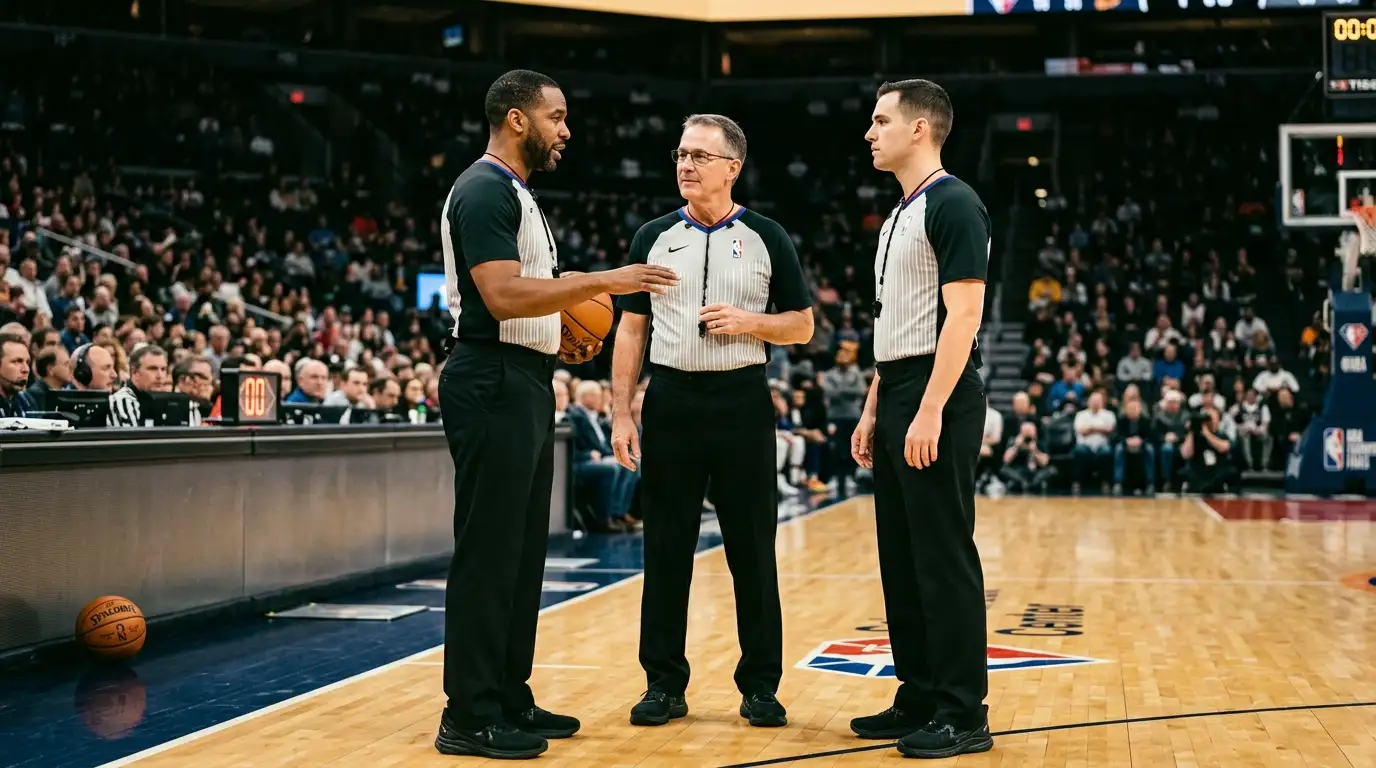
How a referee adjustment changes a totals price
Step 1: You like the over on a 226.5 total at 10/11 (decimal 1.91, implied probability 52.4%).
Step 2: You check the crew. Lead official averages 4.2 more whistles than the league mean, which historically correlates to roughly two extra free-throw trips per team.
Step 3: Two extra trips at a league average free-throw conversion of 78% produces approximately 3.1 expected additional points.
Step 4: That 3.1-point uplift relative to a 226.5 total moves your implied probability of the over from 52.4% to about 56%. The price is still 10/11. Your edge has just doubled.
Step 5: Stake accordingly — and only on those nights when the official's tendency and another signal you already trusted point the same way.
De-vigs the posted total, converts your crew's whistle delta into expected points, shrinks it for sample size, and tells you whether the officiating tilt actually beats the overround.
Edge −0.16 pp — the crew tilt does not cover the 6.93% overround.
Strip out the margin and the market's fair price on your side is 48.99%. The shrunk whistle tilt is worth 3.23 pp of probability, which still leaves you short. You would need roughly +7.0 whistles per game at this sample size before the bet clears a +2.00 pp threshold.
UK fractional price worked example
Over 226.5 — 10/11 (decimal 1.91, implied 52.4%)
Under 226.5 — 5/6 (decimal 1.83, implied 54.6%)
Overround — roughly 7% — meaning the book's no-vig fair line on the over sits at about 48.6%. If your modelled probability of the over is 56%, your edge over the closing line is 7.4 percentage points before fees.
That's the headline workflow. The next four subsections drill into the four pillars underneath it: a high-profile case study, the L2M data stream that makes most of this possible, where to find the actual assignments before tip, and how to translate any of it into UK bookmaker action.
The Scott Foster case study you have to understand
Every NBA referee betting conversation eventually runs into the same name. Scott Foster is the most studied, most criticised, most folklore-laden official in the modern league, and the danger for UK punters is treating his presence as a betting instruction rather than a data point. The reputation is enormous; the actionable edge is smaller and more conditional than it looks.
The folklore traces back to one player-referee history. Chris Paul has lost eleven straight playoff games under Foster, with the broader head-to-head record sitting at one win in his last thirteen meetings. Paul addressed it after Game 3 of the 2021 Finals with the line "If I was a betting man — eleven games in a row," about as direct as a star player gets without naming bias outright. That clip is the seed of every "Series Extender" meme online, usually deployed as a punchline rather than evidence.
Where it gets genuinely interesting for bettors is in Foster's crew chief data across 2023-24. Home teams under his whistle won 68.3% of their games at an average point differential of 7.7 points. ATS, those home teams went 36-26 — a 58% cover rate, comfortably the best ATS home edge of any senior official that season. But pull back one year and the picture flips: home teams went 21-32-1 ATS at 39.6% the season before that. Two adjacent seasons. Opposite verdicts. That isn't randomness, but it isn't a stable signal either.
The honest reading is that Foster has the longest playoff resumé in the modern game — 23 NBA Finals games and 228 playoff appearances across 29 seasons — and the games he's assigned aren't a random sample. Senior crew chiefs get the closest matches, the toughest series, the most pressured environments. His personal tendencies interact with that selection effect in ways that take whole seasons to disentangle, which is why his ATS numbers swing so violently year on year.
For a UK punter, the practical takeaway is narrow. Don't bet the side because Foster's name was on the assignment sheet. Use his presence as a flag that the game probably needs closer modelling than the rest of the slate, and that crowd narratives around his crew will already be priced into anything sharp. The deeper breakdown — career splits, the Donaghy phone-call angle, the Series Extender claim picked apart with current data — sits in our full piece on Scott Foster betting trends.
The L2M data stream that everything sits on
If you remember one thing from this guide, make it this: the L2M reports are the only public window where the NBA marks its own homework. Everything credible in referee handicapping derives from them. I've watched friends spend weekends scraping fan forum threads when the foundation of their thesis sits in a free, downloadable PDF the league publishes 48 hours after the game.
The mechanics are straightforward. L2M reports have been published since March 2015, and the trigger since the 2017-18 season is automatic: any game with a margin of three points or fewer at the two-minute mark of the fourth quarter or any overtime period gets a full audit. Every call, every non-call in that window is graded as correct, incorrect, correct non-call or incorrect non-call. That's roughly 30-50 ratings per qualifying game.
What makes the dataset valuable for bettors is the underdog tilt I mentioned in the academic section. The 23% reduction in errant calls against road underdogs and the 42% reduction against home underdogs aren't blanket effects — they're concentrated in the L2M window where every whistle matters most. The moment the bet decides itself, the bias is at its largest.
Two questions to ask of any L2M data set. First, what's the sample period? Patterns from 2018-19 may have nothing to do with 2025-26 officiating. Second, is the spread close enough to expect L2M coverage? Games with wide closing margins never trigger an L2M report, so any "Foster L2M record" is implicitly filtering for tight games, which biases the data set toward dramatic finishes. Mistake those filters and you'll think you've found gold when you've just found selection bias.
I download the L2M PDFs on Sunday mornings, parse them into a flat table with one row per called play, and update three counters per official: total calls, incorrect calls including non-calls, and beneficiary of the last marginal error. The third counter is the soft one — not whether the official got it wrong, but whether the team that benefited was the favourite, road side, home side, or underdog. After two or three seasons that count tells a story the headline error rate can't.
For a full walkthrough of how to read individual L2M reports, where to download them, and how the Belasen and Pelechrinis methodologies parsed the calls, the longer treatment lives in our piece on the NBA Last Two Minute Report. For pillar purposes: the L2M is the data, it's free, it's official, and most of the punters quoting referee statistics at you have never opened a single one.
How I find tonight's referee assignment before tip-off
The most common question I get from readers is also the simplest to answer badly. "Where do I find tonight's NBA referees?" People want a single source. There isn't one — at least not for UK punters, where the time zone gap puts us in a different rhythm than US bettors. The good news is that the workflow is short once you've built it.
Assignments are typically published by the league or aggregated on third-party sites a few hours before tip-off. For a UK punter watching a 1 a.m. tip, that usually means the names appear sometime between 5 p.m. and 9 p.m. UK time. The window matters because pre-tip line moves, if any, tend to land in the hour after the assignment goes public, not the hour before. If you're a punter who likes to bet two hours before the game, you may be betting blind on the official anyway.
The crew is three officials: a crew chief, a referee and an umpire. The chief carries the most weight, both in decision authority during the game and in public trackers, which list them first. When you read a crew sheet, the chief is the senior name, and that's the name whose tendencies matter most. The two secondary officials still affect foul rate and pace, but the chief's identity is the single largest assignment variable you'll act on.

Pre-bet referee checklist for the UK punter
- Identify the crew chief and the two secondary officials. Note the chief separately.
- Check the chief's home win percentage over the last full season and the current sample.
- Check foul-call splits — road foul rate, home foul rate, totals tendency.
- Cross-reference with the team's own data — is the home side a high-foul team being officiated by a high-foul-rate crew?
- Map the assignment against the L2M window. Is this likely to be a close game, where the underdog tilt matters most?
- Decide whether the official's tendency agrees with the rest of your read. If not, stand down.
Two cautions before you build a routine around this. The NBA can and does reassign officials after the original list publishes — usually for travel or scheduling. If you're betting in the hour before tip, that risk is small. If you're betting eight hours in advance, the assignment might change between your bet and the whistle. Second, playoff assignments work differently — chosen from a smaller pool and announced in a tighter window. The full daily walkthrough, including aggregator sites and timing tactics tailored to UK kick-offs, lives in our piece on NBA referee assignments today.
Translating referee data into UK bookmaker coupons
I once explained an NBA referee bet to a colleague who'd only ever bet horses. He looked at the coupon, looked back at me, and said "this is just a handicap with extra reading". He wasn't wrong. UK bookmakers built their NBA coupons on the same chassis they use for football and racing, which means most of the referee insight has to be expressed through markets that were never really designed for it.
The differences between US and UK NBA betting matter more than punters new to the market expect. They affect which referee edges you can act on and how aggressively the books reprice when news lands.
| Feature | US-style sportsbook approach | UK-licensed bookmaker approach |
|---|---|---|
| Default odds format | American moneyline (+150, -120) | Fractional (5/4, 5/6) with decimal toggle |
| Multi-leg structure | Parlay | Accumulator, treble, Yankee, Lucky 15 |
| Player prop depth | Wide menu per player per game | Narrower menu, especially after October 2025 unders memo |
| Half-time bias | Live half-time totals common | Half-time markets exist but less aggressively priced |
| Same-game multi | Same Game Parlay | Bet Builder or equivalent in-house brand |
| Best Odds Guaranteed | Rare on team sports | Common on racing, occasional on NBA promos |
The structural detail UK punters most need to absorb in 2026 is the Remote Gaming Duty rise. The rate jumped from 21% to 40% on 1 April 2026, and that's already biting into operator margins — Entain Group reported a £681 million loss including a £488 million impairment off the back of the change. The patterns to watch are tighter overrounds on headline markets and reduced promotional spend. Neither directly affects how an NBA referee edge translates, but both affect the size of edge you'll find at the closing line.
How a fractional-odds NBA total converts when you've factored a referee edge
Posted total: Under 222.5 at 10/11 (decimal 1.91)
Implied probability of the under at posted odds: 52.4%
Your modelled probability with crew adjustment: 56.0%
Edge over the price: 3.6 percentage points
Stake sized using fractional Kelly at 0.25 of edge: small but consistent — even a small edge at 10/11 compounds across a long sample.
The full UK-localised handicapping workflow — fractional-to-decimal conversion, accumulator structures, where in your slip the referee read should live, and how the RGD shake-out is affecting individual market depth — sits in our dedicated piece on NBA referee handicapping for UK punters. For pillar purposes you have the chassis: UK markets are built on different mechanics, the same referee read translates differently across them, and the closing price after the RGD change is meaner than it was a year ago.
From Donaghy 2007 to the 2025 prop-bet scandal — what changed for bettors
I've had this conversation in pubs more times than I can count. Someone hears that I write about NBA refs and within ninety seconds the name Tim Donaghy comes up. The case is older than smartphones, but it still defines public suspicion of the entire officiating crew. What's changed in 2025 isn't the suspicion. It's that the league finally has a second scandal of the same magnitude — and this one involves players betting on themselves, not officials betting on games. That's a different problem with a different fix, and UK punters need to know how it reshapes the market.
The original scandal first. Between October 2006 and April 2007, Tim Donaghy placed 134 telephone calls to Scott Foster — most under two minutes, most clustered around games Donaghy was betting on. The Pedowitz Report in 2008 reconstructed the pattern. Donaghy went to federal prison. Foster was cleared. The investigation became the foundation of the league's modern referee oversight regime, and it's the reason Foster's name now travels with a footnote it didn't ask for.

For seventeen years that was the dominant integrity story. Then 2025 happened. Adam Silver spoke about it on Amazon Prime during a Celtics-Knicks broadcast in October — "My initial reaction was I was deeply disturbed. There's nothing more important to the league and its fans than the integrity of the competition, so I had a pit in my stomach. It was very upsetting." That quote landed the same week the federal indictments unsealed.
The Rozier piece is the simplest to follow. In March 2023, $257,700 in bets were placed across platforms on Terry Rozier's "unders" — one Mississippi bettor alone made 30 separate stakes totalling $13,759 on a single game. The numbers triggered integrity monitors in real time. The Porter case followed a similar pattern at scale: Jontay Porter placed at least 13 bets through someone else's account between January and March 2024, totalling $54,094 in stakes ranging from $15 to $22,000. When sportsbook prop limits sit around $1,000-$2,000 a ticket, attempts at $10,000-$20,000 stand out.
The league's response was the policy shift UK punters actually need to absorb. After the Porter ban in April 2024, the NBA formally asked sportsbooks to pull "under" player-props from all players on two-way and 10-day contracts. The major US books — FanDuel, DraftKings and BetMGM — agreed. UK-licensed operators followed the same pattern with their own NBA prop menus. If your strategy in 2024 leaned on under-prop arbitrage against marginal players, that whole category effectively closed.
Why this matters for ref betting specifically: the 2025 scandal didn't involve officials, but it changed the integrity infrastructure around the entire NBA product. Sportradar's monitoring volume, the league's prop-bet policy, the regulatory tone of state and overseas oversight — all tightened. UK punters now bet into a market where basketball-specific integrity flagging has visibly increased, and where the league's posture toward unusual line movement is more reactive than it used to be. The good news is the integrity layer is doing its job. The bad news, for the lazy punter, is there's less slack in the system to exploit than there was eighteen months ago.
The responsible gambling layer UK punters can't ignore
I want to be honest about why this sits in a pillar about referee handicapping rather than tucked away in a footer. The kind of bettor most interested in NBA officials is also the kind most likely to keep refreshing their slip late at night, drilling into ever-narrower edges, betting through tip-offs that finish at 4 a.m. That profile and problem gambling overlap more than the punter wants to admit.
The most recent Gambling Survey for Great Britain put the proportion of UK adults with a Problem Gambling Severity Index score of 8 or higher at 2.7% — roughly 1.4 million people. Among 18 to 24-year-olds, that PGSI 8+ band jumps to 5.3%. GamCare reported 1,954 referrals to its Money Guidance Service in 2025 following gambling losses — more than double the 923 in the previous year, with cumulative debt across those cases of £7.2 million, averaging £21,269 per referral.

The UK regulator's response is a "light-touch" financial vulnerability check that activates for customers staking more than £150 a month. It doesn't require any action from the customer, doesn't affect a credit score, and is meant to catch the early signals before the deeper, more intrusive affordability checks become necessary. The £150 threshold matters because casual NBA bettors rarely hit it, but engaged ref-handicappers running ten or fifteen accumulators a week often do.
Three tools every UK NBA punter should know exist. GAMSTOP, the national self-exclusion scheme, blocks access to every UKGC-licensed operator for the period you set — six months, one year, or five years. GamCare runs the National Gambling Helpline and the Money Guidance Service referenced above. Every UKGC-licensed bookmaker offers deposit limits, loss limits and session reminders inside the account — none of these features hurt your win rate; they just make sure a bad month doesn't become a bad year.
Questions UK NBA bettors keep asking me
Does an NBA referee actually move the line at UK bookmakers?
Rarely, and never on the moneyline. UK trading desks model team strength, pace, rest and injuries — referee identity is a flagged but unweighted input on most books. When you do see a small price move after an assignment lands, it's usually retail money piling onto whichever narrative the public has latched onto rather than a sharp adjustment by the book. The value lives in the gap between the book's neutrality and your own model, on the small subset of nights where the official's tendency and your other inputs both point the same direction. VSiN's first-half 2025-26 figures put the majority bettor's NBA moneyline ROI at minus 20.2%.
How do I find tonight's NBA referee assignments from the UK?
Assignments are published by the league and aggregated on third-party referee-tracking sites a few hours before tip-off — that lands between roughly 5 p.m. and 9 p.m. UK time for a typical 1 a.m. game. The chief, referee and umpire are listed in that order. For a UK punter who likes to bet two hours before kick-off, the assignment is often unavailable at the moment you'd place your bet, which is a structural reason to either bet later in the window or accept that the ref signal won't make it into your slip.
What is the NBA Last Two Minute Report and why does it matter for bets?
The L2M is the NBA's public per-call audit of any close finish — games with a margin of three points or fewer at the two-minute mark of the fourth quarter or any overtime. Published since March 2015 and automated since 2017-18. Every call and non-call in the L2M window is graded as correct or incorrect. For bettors it's the only official, downloadable record of where the league itself thinks officials got it wrong, and it underpins Belasen's 23% road-underdog finding, Pelechrinis's home-bias paper and McDermott's time-remaining work.
Is NBA betting legal in the UK in 2026?
Yes, when placed with a UK Gambling Commission-licensed operator. The Gambling Act 2005 governs the framework. The 1 April 2026 Remote Gaming Duty rise from 21% to 40% affects operator margins and may slightly tighten the odds you see, but doesn't change the underlying legal status of placing NBA bets. Anyone 18 or older can hold a UKGC-licensed account and bet on NBA games. Stick to licensed operators — anything offering NBA markets without UKGC oversight is outside the consumer-protection framework.
Did the 2025 prop-bet scandal change how I should bet NBA player props?
Materially, yes. After the Jontay Porter ban and the federal indictments around Terry Rozier's March 2023 unders, the NBA asked sportsbooks to pull "under" player-props on all players holding two-way or 10-day contracts. Major US books agreed and UK-licensed operators followed similar patterns. If your previous strategy involved hunting unders on marginal rotation players, that category effectively closed. The integrity-monitoring layer is also more reactive than it was, so unusual line movement now attracts faster scrutiny.
What does the academic research actually say about NBA referee bias?
Three findings. Belasen et al. in 2025 measured a 23% reduction in errant calls against road underdogs and a 42% reduction against home underdogs in close-game L2M windows. Pelechrinis in 2023, using 7,498 personal foul calls, confirmed a persistent home tilt that shrank during the COVID bubble — Sagarin home court advantage fell from 2.74 points across 2015-19 to 1.75 across 2020-22. Price and Wolfers's 2010 own-race bias finding disappeared in the 2018 follow-up, attributed to awareness reducing unconscious bias. Bias is real, measurable, and small enough to be missed by anyone not looking.
Where does Scott Foster's reputation come from — is it just folklore?
Both. The folklore is genuine — Chris Paul has lost eleven straight playoff games under Foster and went 1-12 across his last thirteen meetings, and Paul himself addressed it on camera with "If I was a betting man — eleven games in a row." The data is more conditional. Foster's home-team ATS swung from 39.6% in 2022-23 to 58% in 2023-24, more consistent with selection effects from being assigned the toughest games than with any stable directional bias. His resumé — 23 Finals appearances, 228 playoff games, 29 seasons — means he gets the games where the narrative is loudest, which amplifies perception beyond what the numbers can carry.
Player prop (proposition bet) — A bet on an individual player's statistical line in a single game — most commonly points, rebounds, assists, or combined PRA totals. The post-2025 NBA memo affects this market most directly.
How I'd actually use this guide tomorrow night
If you take one habit from these six thousand words, make it this: don't bet the referee. Bet the game, and use the referee to confirm or reject what you already think. Every winning use of officials data I've logged across nine years has worked that way. Every losing one started with a name on a coupon and worked backwards.
The pattern I follow before any UK midweek slate looks like this. Build your view on team, pace, rest and matchup first. Note the assigned crew chief when the names land. Cross-check the chief's tendencies against your existing read. Bet only the games where the two agree, and stake conservatively. Track every bet in a spreadsheet — official, market, posted price, modelled price, result — and review monthly. Six months in and you'll know whether you actually have a referee edge or whether you've been telling yourself a story.
The serious money in NBA ref betting isn't found in shouting about Scott Foster on social media — it's in the quiet, repetitive work of matching crew tendencies against close totals and ATS lines, with disciplined staking and a UK regulator-aware bankroll. Read the L2M. Track the splits. Ignore the noise. The market doesn't price officials, which is your opportunity and your warning sign at the same time.
