
 Available in US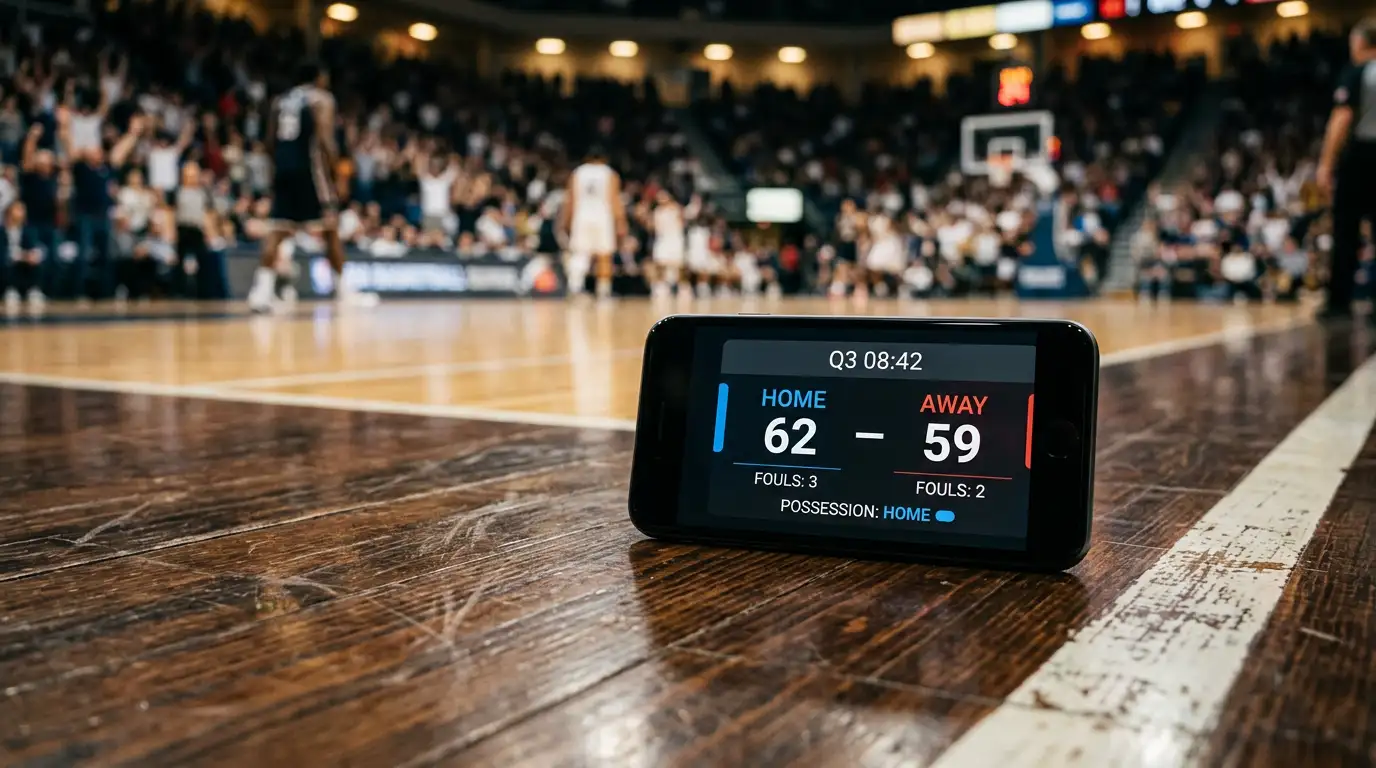
Live Trading Strategy – Capitalizing on First-Quarter Foul Tells
Most of my live NBA betting decisions are made before the game crosses the first media timeout. The reason is uncomfortable for anyone who thinks live betting is about reacting to the action: the action you most need to read is the action you can predict from the assignment sheet plus the first few possessions, and the live market is at its loosest when in-play traders are still calibrating against the actual on-court tempo. The window is six to eight minutes wide. After that, the prices tighten and most of the asymmetric value disappears.
The connection to referee data is direct. Live in-play models that the major UK operators run incorporate refereeing crew identity in the closing line for the total and the spread, but they incorporate it incompletely. The first quarter is where you get to see whether the crew is actually calling the game in the style their season data predicted, and where the live total has not yet adjusted to the observed calling rhythm. NBA outcome prediction models in published academic work hit an average accuracy of about 66 per cent with a high-end of 78 per cent. The in-play models the books run sit closer to that high-end on quiet stretches but slip toward the average during the first quarter, which is precisely when the referee read is most informative.
Live betting requires quick decisions, especially when considering NBA cash-out mechanics and referee-driven swings during the crucial third quarter.
What the UK in-play market actually looks like for NBA
The UK NBA in-play market in 2026 is structurally different from the US version, and the differences matter for how you bet it. The big UK operators offer continuous markets on totals, spreads, and moneylines throughout the game with sub-minute refresh rates on the headline lines. Player-prop in-play markets are thinner than the US equivalents – fewer combination lines, fewer rebound-and-assist live markets, fewer alternative spreads. The depth is concentrated on the main markets rather than the niche tree.
Roughly 8 per cent of UK adults bet online on sports in any given quarter, a number that has stayed broadly stable through the recent regulatory cycle. NBA is a minority sport in that share – football dominates at 6 per cent of adults specifically – which means NBA in-play volume on UK books is thinner than what equivalent markets see in the US. Thinner volume produces wider in-play margins and slower line corrections, which is good and bad for a sharp bettor. The pricing is looser, which creates opportunities, but the available stake size is smaller, which constrains how much you can put through on any single observation.
The other UK-specific consideration is the in-play interface itself. Most UK books embed the in-play market within a video-feed environment that lags the actual game by between two and six seconds. Two to six seconds is enormous for NBA, where a single possession can swing the in-play total and spread by half a point each. The pricing the in-play market shows you is several seconds behind the action, and the trader on the other side is using a faster feed than you. That asymmetry is real and it is the structural reason most public in-play strategies do not work without specific edges that compensate for the latency cost.
The early-quarter foul-count tell
The single most reliable in-play referee signal I work from is the foul-count divergence in the first six minutes. Most bookmaker in-play models assume the crew will officiate at roughly their average pace for the season. When they do, the live total does not move much off the closing line. When they do not – when the crew is calling materially tighter or looser than expected – the divergence creates a window for action.
The specific signal: at the first media timeout, around the eight-minute mark of the first quarter, the league average for total fouls called sits at roughly three to four combined. If you see a crew at seven or eight combined fouls at that timeout, the crew is calling a tight game and the over on the total is mispriced. If you see one or two combined fouls at the same point, the crew is letting play breathe and the under is mispriced.
The reason the mispricing exists is that the in-play model needs six to eight minutes of data to confidently update its prior on the crew. Until the model has enough observations, it is leaning on the closing line’s assumption. The closing line incorporated an estimate of expected fouls per game but not the realised pace of the first eight minutes. Your edge sits in that gap. Once the model has caught up – typically by the end of the first quarter – the in-play prices have absorbed the new information and the gap has closed.
This signal works best on crews with measurable directional splits like Eric Lewis or Natalie Sago, because the gap between expected and observed calling rhythm is more often material when the crew is one with strong tendencies. League-average crews tend to call closer to expectation, and the in-play model is less likely to be wrong about them.
Mid-game style reads and how they shift the lines
The middle two quarters are where most live in-play volume sits and where the asymmetric value is hardest to find. Pricing tightens, traders have full data on the crew’s calling rhythm for the night, and the obvious mispricings of the early window have largely closed. What is still available is style-based reading on specific situational markets.
The most common: foul-trouble swings on star players. When a star picks up their third foul in the second quarter, in-play totals and spreads adjust to reflect the expected minutes reduction. The adjustment is usually mechanical and often overshoots, particularly when the star is on the home side and the crew’s directional split predicts the foul rate against that team is unsustainable. A second-quarter third foul on a home star under a Sago-style crew is a different signal from a second-quarter third foul on a home star under a Lewis-style crew, because Lewis is going to keep calling against the road team while Sago will keep calling against the home team. The in-play model knows both of these tendencies but does not always weight them correctly in the moment of the third-foul adjustment.
The bet is usually on the team whose star has just picked up the third foul, against the spread, in the next few minutes. The market is over-reacting to a single-foul event when the crew’s underlying pattern suggests the foul rate is unlikely to accelerate against that side for the rest of the half. That is a contrarian bet but a structurally sound one when the crew read supports it.
Clutch time and the L2M-window overlay
The final two minutes of any close NBA game are the highest-leverage and highest-monitored window in the sport. The Last Two Minute Report covers exactly this window, and the academic work on home-court bias finds the strongest effects in the L2M window – bias signals concentrate when stakes are highest and discretionary calls multiply. For a live bettor, that translates into a specific edge structure in the last two minutes of a tight game.
The setup: if the game is within three points entering the L2M window and the visiting team is the trailing side, the underlying academic evidence suggests the home crew will, on average, make more accurate calls against the home team during the window – a small effect, but a real one. The implication is that the visiting team is slightly more likely to convert the late possessions favourably than the in-play model implies, because the model is calibrating on the full-game home advantage and not on the L2M-specific bias reversal.
I want to be careful with this signal because the effect is small and the in-play markets in the L2M window move fast. The realistic application is not “bet the visiting team” but rather “fade obvious home-team momentum bets in the L2M window if the closing total and the realised total agree that the game stayed tight.” It is a contrarian sentiment trade more than a directional one, and it is one of the situations where partial cash-out can lock in expected value rather than expose you to the high variance of the final possessions.
Maximize your live betting ROI with the professional resources available at nbarefbetting.
The in-play risks that cancel most theoretical edges
I want to close with the honest accounting of why in-play NBA betting is harder than it looks. The latency between the broadcast feed and the operator’s pricing engine is two to six seconds on UK books, which is roughly two possessions of NBA action. The operator is pricing on a feed faster than yours. Your edge needs to be large enough to overcome that latency cost on every bet you place.
The other in-play risk is cash-out asymmetry. Operators offer cash-out on most in-play NBA markets but the cash-out price is set with a margin in the operator’s favour that is typically larger than the margin on the underlying market. Taking a cash-out is rarely a positive-EV decision unless the situational reasons for closing the position are unrelated to expected value – bankroll management, sleep, the desire to lock in a profit rather than carry exposure into the final minutes. The cash-out on NBA bets when referees swing the game piece breaks down when cash-out is and is not worth using on referee-driven in-play positions.
The bottom line on in-play NBA betting with referee angles is that the edges are real, the windows are narrow, and the execution discipline required is high. The early-quarter foul-count tell is the cleanest edge and the one I trade most often. The mid-game style reads are useful but lower-conviction. The L2M overlay is genuinely fascinating academically and difficult to execute on retail platforms because of the latency cost. Pick your spots carefully, size them appropriately, and treat in-play as one tool in the workflow rather than the primary lever.
Articles
Published by the nbarefbettin team.
